ROCK ART · RITUAL SYMBOLS · INDUS SEALS
Edited by : TJ
A comparative perspective on Hongshan-related rock art and Indus Valley sealsOverviewRegional EvidenceIndus SealsSymbol MatrixReferences
Birth, Protection, and Ancestral Continuity
Across northern China, rock art panels record a visual language of fertility, protection, sacrifice, and ancestral memory. Human faces, branching signs, animal offerings, bows, arrows, dogs, bulls, sheep, deer, and camels appear together in carefully organized compositions.
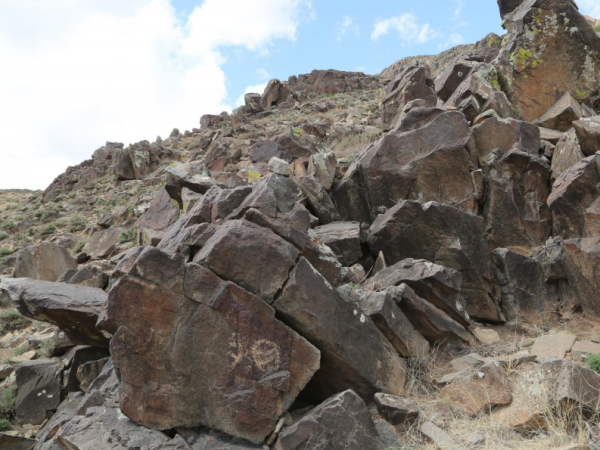
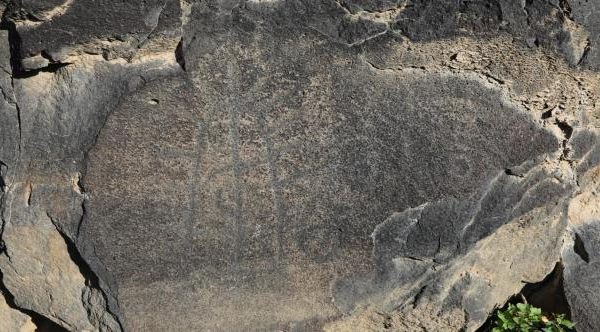
The imagery presented here extends the discussion of Hongshan-related symbolic culture into a wider northern corridor, including the Yinshan Mountains, Zhuozi Mountain, the Helan Mountains, Gansu, Qinghai, and the western plateau. Although the dating of many petroglyphs remains difficult, the recurrence of comparable motifs suggests a broad ritual vocabulary concerned with childbirth, clan continuity, and the protection of life.
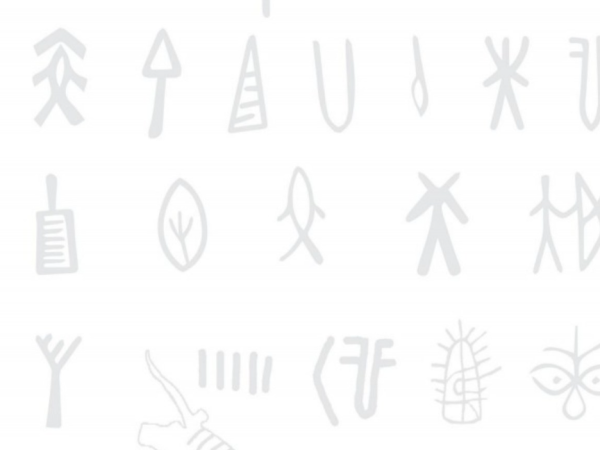
Several signs are interpreted through their visual resemblance to later Chinese graphs such as sheng 生 (“birth/growth”), zu 祖 (“ancestor”), zi 子 (“offspring”), shi 射 (“shoot”), and bu 卜 (“divination”). These readings are best understood as comparative and iconographic interpretations, not as claims of a fully deciphered writing system.
Research Approach
This presentation combines visual comparison, contextual interpretation, and regional distribution. The focus is not on proving a one-to-one script equivalence, but on showing how early communities used durable images to express ideas of reproduction, ritual protection, ancestral power, and social renewal.
7regional clusters
9major rock-art examples
2central ritual themes
1comparative framework
Regional Evidence from Northern Chinese Rock Art
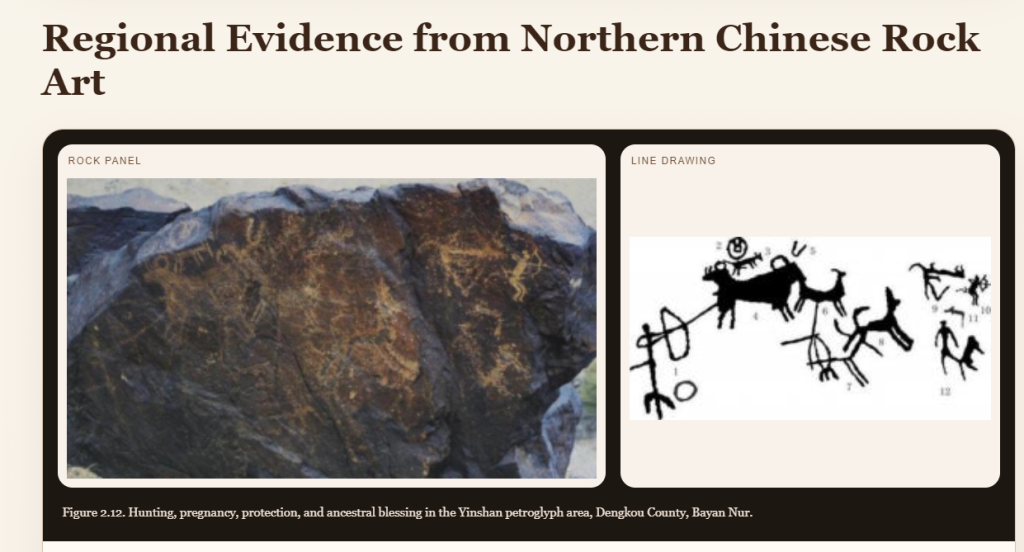
YINSHAN · JUN UDA
Pregnancy Protected by Ancestors and Guardian Animals
This composition brings together a proposed pregnancy-related sign, an ancestor-like sign, sheep, a dog, a two-headed ox, human figures, and repeated shooting or bow-related forms. The scene may be read as a ritual narrative of difficult pregnancy: sheep function as offerings, the dog as a guardian, and the shooting motif as a protective act against harmful forces.
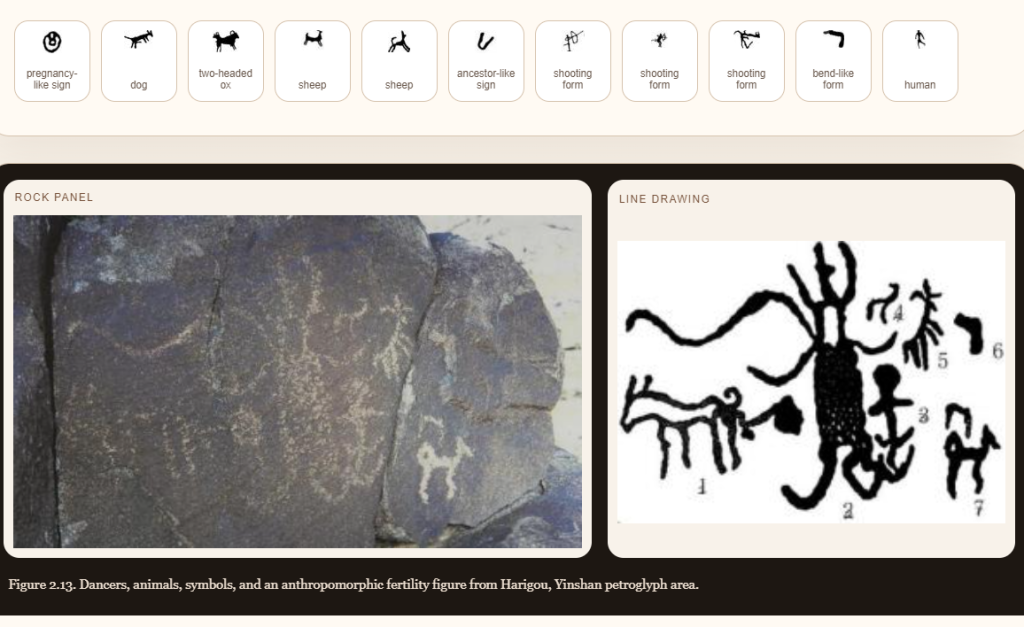
YINSHAN · HARIGOU
An Anthropomorphic Figure of Birth and Offspring
A full-body anthropomorphic figure is identified as carrying a birth-related sign above or within its body. Around it appear animals interpreted as sheep and an offspring-related sign. The visual arrangement suggests a ritual focus on fertility, continuity, and the hope for successful childbirth.
The composition presents fertility as an embodied power: the human-like form serves as a symbolic center, while sacrificial animals and offspring signs support the idea of clan renewal.
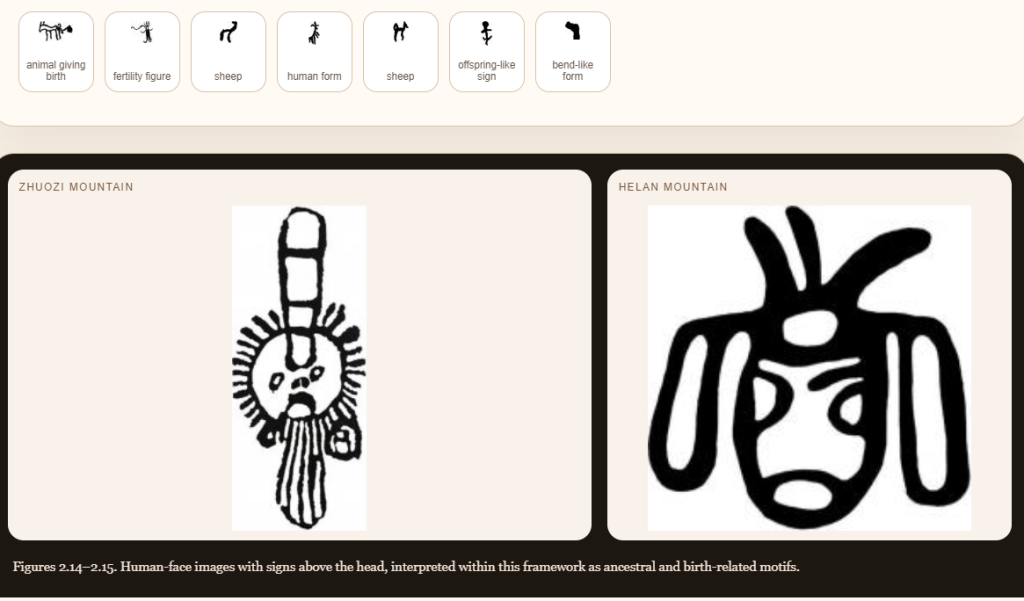
ZHUOZI · HELAN
Human Faces, Solar Rays, and Ancestral Power
The Zhuozi Mountain image shows a human face surrounded by radiating lines and crowned by a sign compared with an ancestor-related form. The radiating structure recalls solar imagery and suggests that ancestral power may have been imagined as luminous, protective, and life-giving.
The Helan Mountain image places a birth-related motif above a human face. Together, these examples point to a recurring symbolic structure: the head or face becomes the site where birth, ancestry, and sacred authority are visually connected.
ancestor-like crown
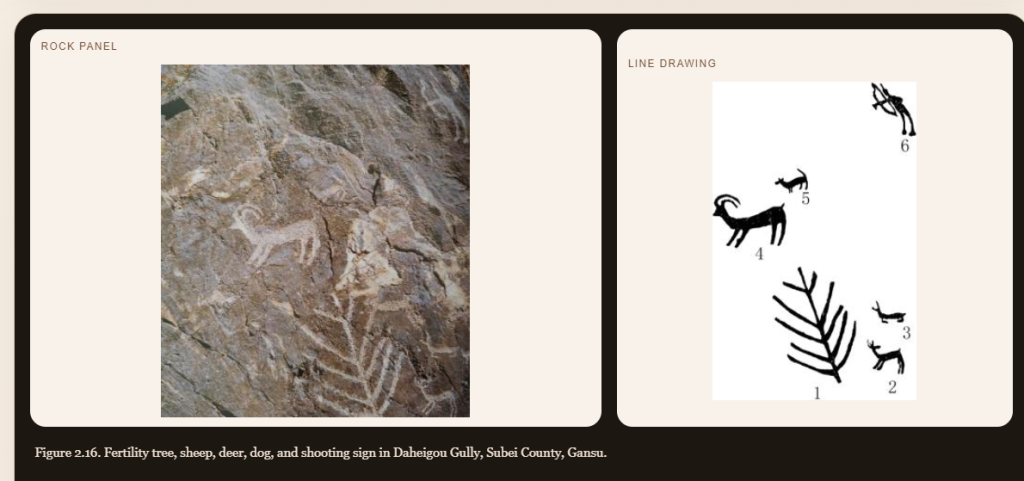
GANSU · DAHEIGOU I
The Fertility Tree and Protective Deterrence
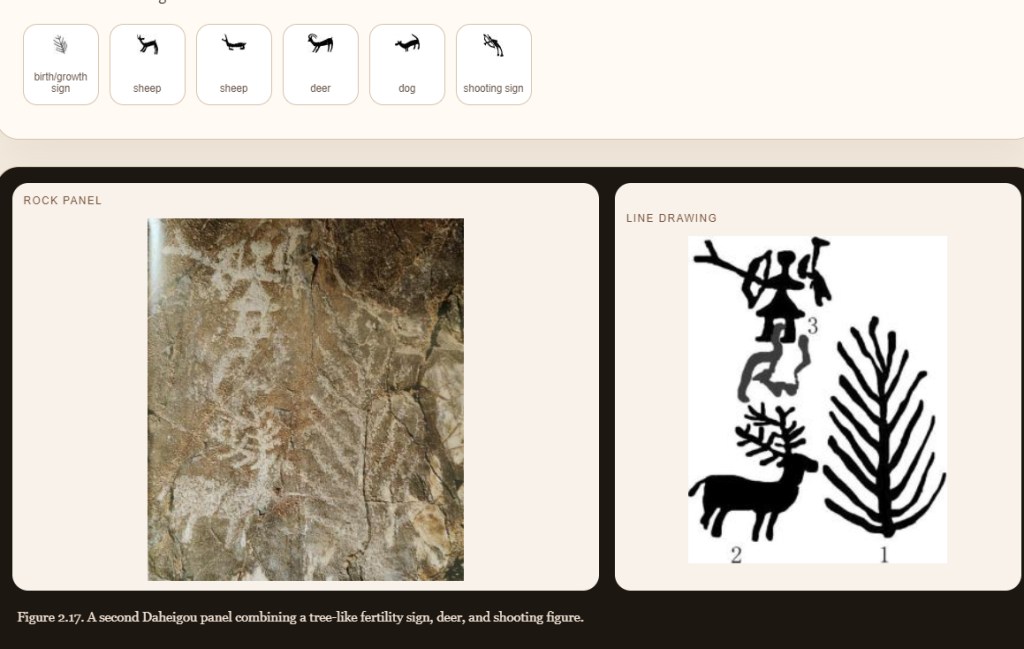
A branching tree-like figure is interpreted as a birth or growth sign, accompanied by sheep, a deer, a dog, and a shooting-related symbol. The tree form suggests luxuriant growth and endless life, while the animals create a ritual setting of offering, auspiciousness, and protection.
The dog and shooting motif may represent protective forces. The scene therefore connects biological reproduction with a moral and ritual order in which birth must be guarded.
GANSU · DAHEIGOU II
Deer, Evergreen Life, and the Driving Away of Harm
This related Daheigou composition repeats the association of a branching birth/growth motif with an animal offering and a shooting figure. The deer may represent auspicious power or ritual offering, while the shooting figure indicates action against harmful influences surrounding childbirth.
birth/growth sign
deer
shooting sign
QINGHAI · CHAHANTEMAI
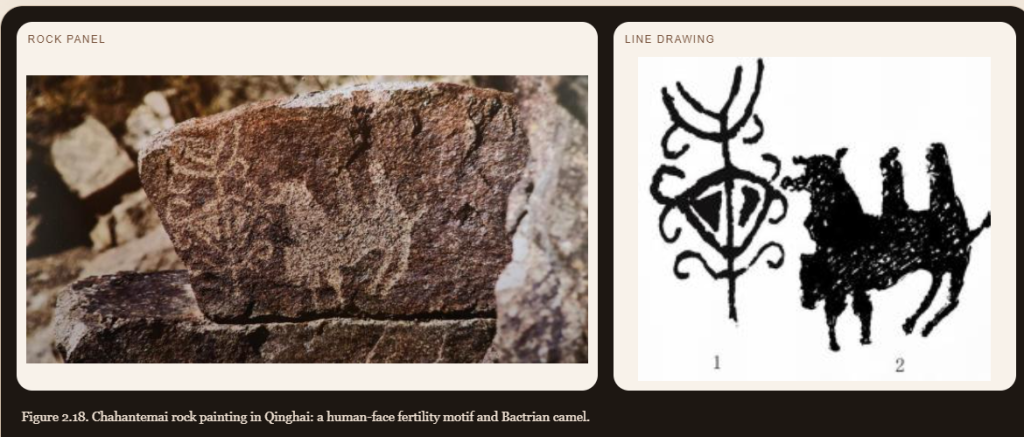
Fertility Totem and Bactrian Camel
The Chahantemai panel combines a human-face sign, interpreted as birth-related, with a Bactrian camel. In the plateau and desert-margin environment, the camel was not merely an animal image but also a marker of mobility, survival, and exchange.
The pairing of a fertility figure and camel may express prayers for the continuity of people, herds, and routes across an arid landscape.
fertility face
Bactrian camel
QINGHAI · LUSHAN MOUNTAIN
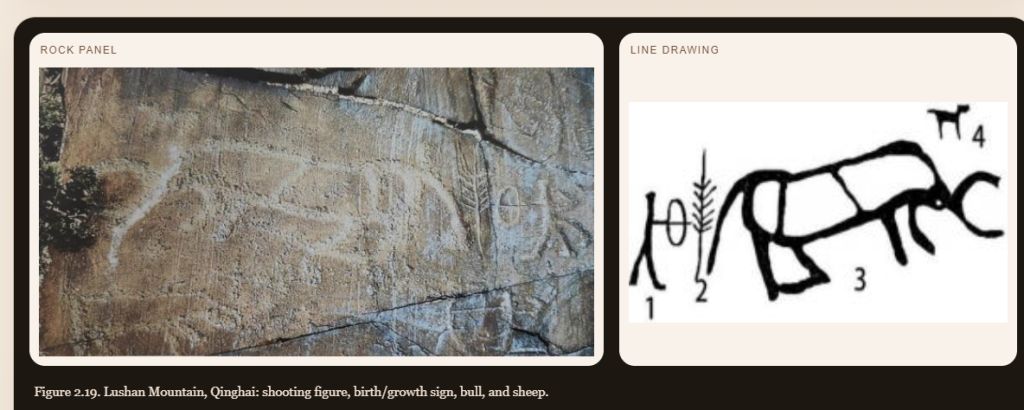
Bulls, Sheep, and Birth Protection
The Lushan Mountain panel contains a human-shaped shooting figure, a birth/growth sign, a bull, and a sheep. The bull may have served as a powerful protective image, while sheep appear repeatedly in northern rock art as offerings associated with fertility and prosperity.
XIZANG · RITU COUNTY
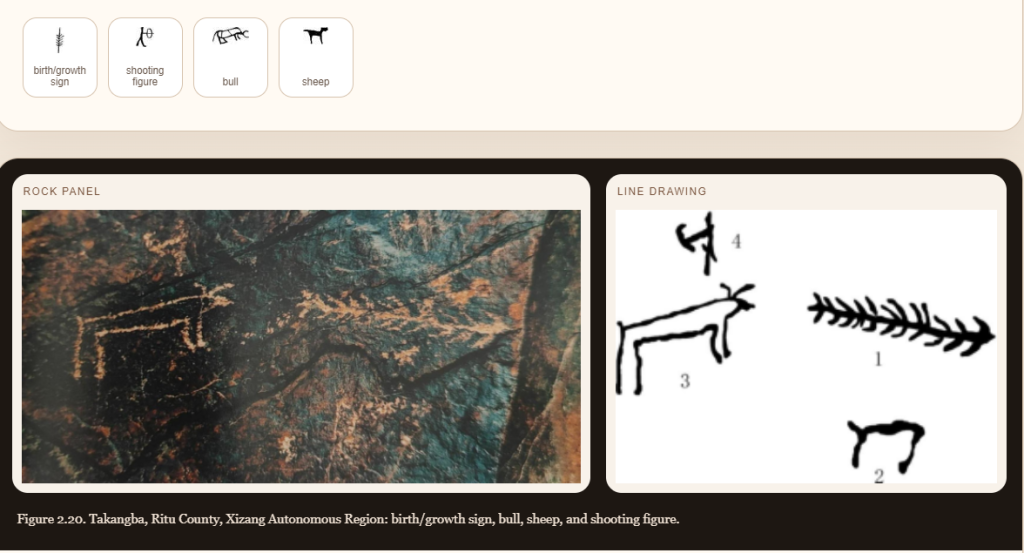
Plateau Sacrifice and Protective Force
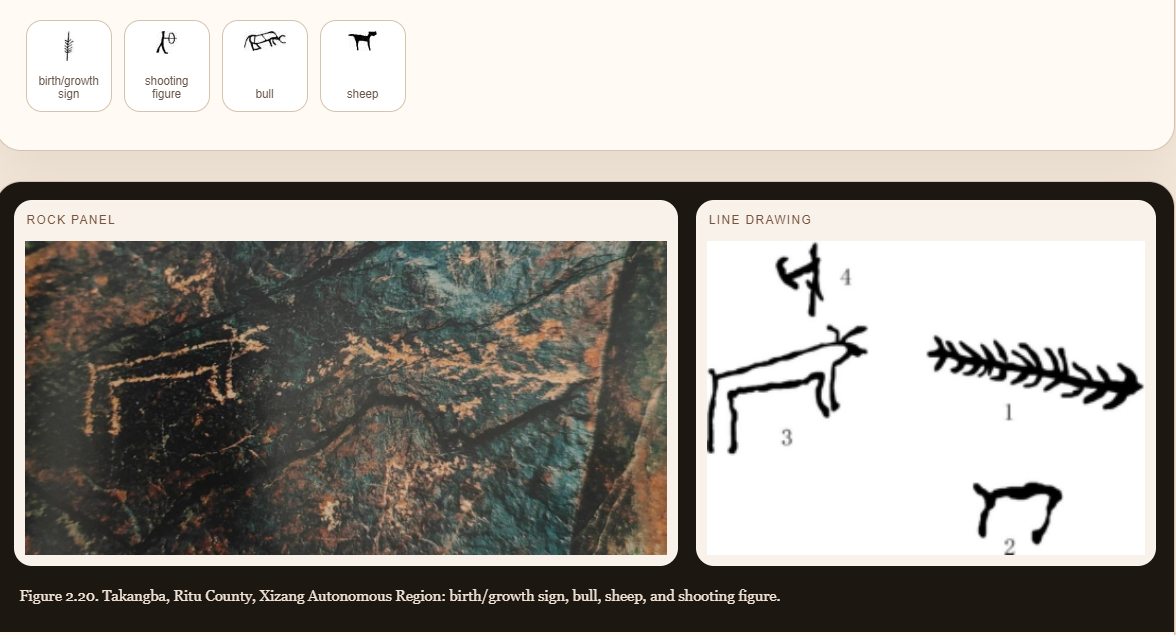
At Takangba, the composition again combines a birth/growth sign with a bull, sheep, and a shooting figure. The recurrence of this combination across distant areas suggests that reproductive protection was a major symbolic concern across northern and western rock art landscapes.
birth/growth sign
sheep
shooting figure
Core Interpretive Findings
1. Fertility is shown as guarded life.
Birth-related signs often appear with dogs, bulls, shooting figures, or arrows, suggesting protection against danger.
2. Animals act as more than decoration.
Sheep, deer, bulls, dogs, and camels appear as offerings, guardians, auspicious beings, or markers of livelihood.
3. Ancestors and birth are visually linked.
Human faces, crowned signs, and radiating motifs suggest that ancestry was imagined as a source of life and continuity.
4. Regional styles form a shared symbolic corridor.
From Inner Mongolia to Qinghai and Xizang, different local styles preserve comparable themes of reproduction, sacrifice, and protection.
Regional Symbol Matrix
The following matrix presents representative fertility and ancestor-related symbol groups across northern China. The variation in style is significant, yet the repeated pairing of birth/growth motifs, animals, offerings, and ancestor-like forms indicates a broad ritual vocabulary.
| Region | Fertility-related symbols | Ancestor-related symbols |
|---|---|---|
| Chifeng rock art | ||
| Yinshan Mountains | ||
| Zhuozi Mountain, Wuhai | ||
| Helan Mountains, Ningxia | ||
| Gansu | ||
| Qinghai | ||
| Xizang Autonomous Region |
Selected References
- Wang Jianping and Zhou Chunyu, The Rock Paintings of Yinshan Mountains, Vol. 2. Shanghai: Shanghai Ancient Books Publishing House, 2010.
- Liang Zhenhua, The Rock Paintings of Zhuozishan Mountain. Beijing: Cultural Relics Publishing House, 1998.
- Li Wei and Zhang Chunyu, The Rock Paintings of Helan Mountain, Vol. 3. Shanghai: Shanghai Ancient Books Publishing House, 2007.
- Chen Zhaofu, Complete Collection of Chinese Rock Paintings: Rock Paintings in the Western Region, Vol. 1. Shenyang: Liaoning Fine Arts Publishing House, 2006.
- Wang Jingzhai, The Historical Scroll on the Rocks: The Rock Paintings in Western Qinghai. Beijing: China Nationality Photography Art Publishing House, 2012.
- UNESCO World Heritage Centre, Sites of Hongshan Culture: Niuheliang, Hongshanhou and Weijiawopu.
- Harappa Archaeological Research resources on Indus seals, inscriptions, and the undeciphered Indus script.
Rock Art · Seals · Early Symbolic Systems
© Research Presentation