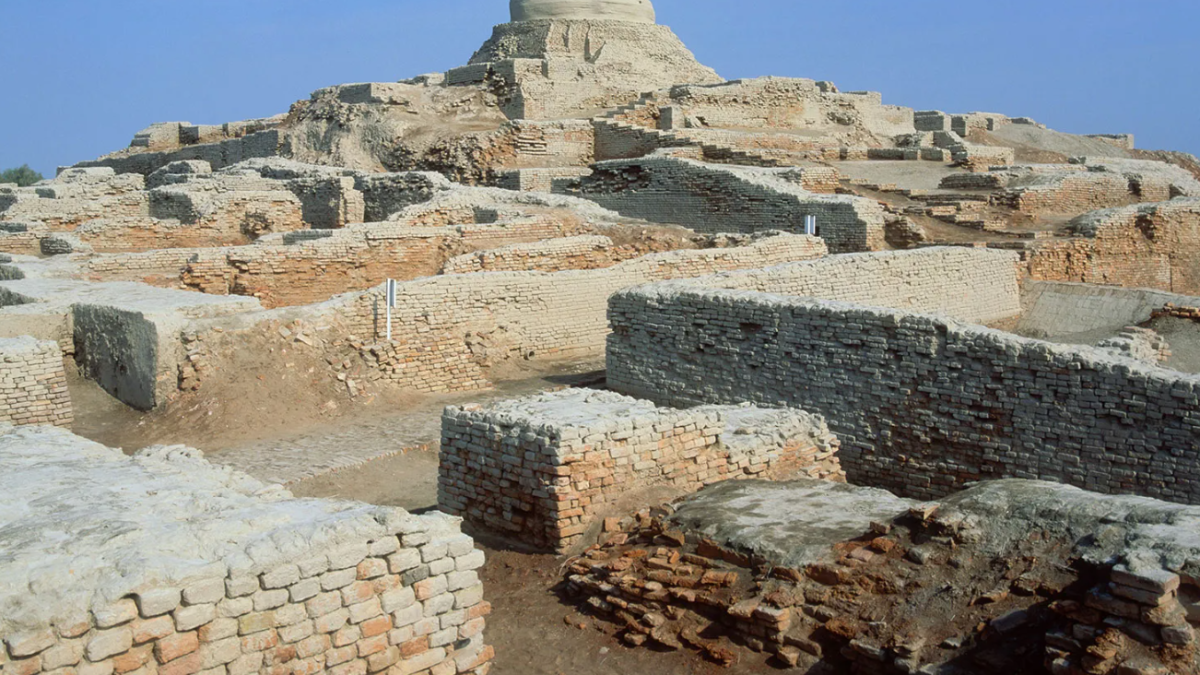
The Mohenjo-daro site (27°19′N, 68°08′E) is located about 28 kilometres south of Larkana District in Sindh Province, Pakistan, on the western bank of the Indus River. Covering an area of approximately 2.4 million square metres, it is one of the largest and best-preserved urban sites of the Indus Valley Civilisation discovered to date (Figure 1.2). The discovery and excavation of Mohenjo-daro have greatly deepened scholarly understanding of the scale, urban planning, and social organisation of the Indus Valley Civilisation.
The ruins of Mohenjo-daro were identified in the early twentieth century by archaeologists working under the Archaeological Survey of India. In 1922, the site attracted wide scholarly attention following investigations associated with R. D. Banerji. From 1923 to 1930, extensive excavations were conducted by teams led by John Marshall, K. N. Dikshit, Ernest Mackay, and other archaeologists. Later investigations were carried out in 1945 by Ahmad Hasan Dani and Mortimer Wheeler. The most recent large-scale excavation was conducted from 1964 to 1965 under the direction of George F. Dales. After this period, large-scale excavation was restricted because exposed structures were increasingly threatened by weathering and environmental damage. Since 1965, archaeological work at the site has mainly focused on artefact rescue, surface surveys, conservation, and site management. In the 1980s, German and Italian research teams led by Michael Jansen and Maurizio Tosi conducted further surveys and architectural investigations, providing additional evidence for the study of the city’s layout and development.
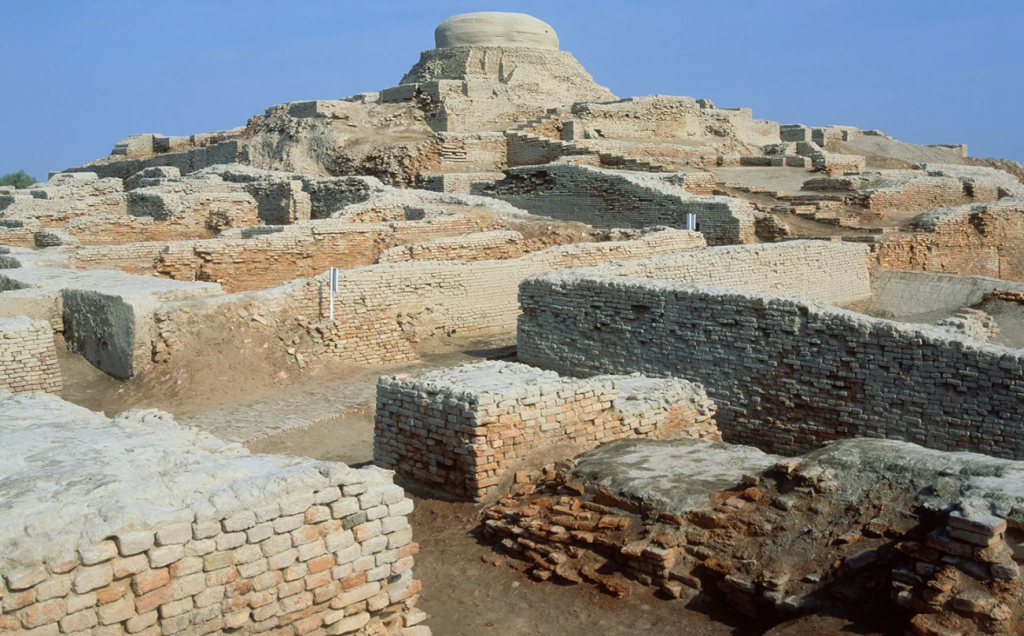
Figure 1.2 Mohenjo-daro Site
One of the most remarkable structures at Mohenjo-daro is the Great Bath. It is generally regarded as one of the most representative examples of public architecture in the Indus Valley Civilisation. Built of baked bricks and equipped with a carefully designed drainage system, the Great Bath suggests that water management and ritual activities may have played an important role in the urban life of Mohenjo-daro. Some scholars have interpreted the structure as a place for ritual bathing or purification, while others have discussed its possible connection with public or ceremonial activities. Although its precise function remains debated, the Great Bath clearly reflects the advanced architectural techniques and organisational capacity of the city.
Another important feature of Mohenjo-daro is its citadel mound. The citadel was built on an elevated platform and contained several large public structures, including buildings interpreted as assembly halls, storage facilities, and rooms possibly used for administrative, ritual, or communal purposes. The elevated position and massive brick construction of the citadel suggest that it may have served as an important public or administrative area within the city.
The lower town of Mohenjo-daro was arranged in a highly organised urban pattern. Residential areas were divided into blocks by streets and narrow lanes, many of which followed a grid-like layout. Houses were usually built of mud bricks or baked bricks and often contained rooms, courtyards, wells, bathing areas, and drainage channels. Some houses may have had more than one storey, with the ground floor possibly used for storage or daily activities and the upper floors for living. The existence of household drainage systems and public drains indicates a high level of urban planning and concern for sanitation.
Mohenjo-daro also appears to have been an important centre of production, trade, and commerce. Archaeological discoveries, including seals, weights, pottery, ornaments, tools, and craft products, suggest that the city maintained economic connections with other parts of South Asia, Central Asia, and the Near East. The surrounding agricultural lands along the Indus River would also have provided an important material foundation for the city’s development. Although excavations at Harappa and Mohenjo-daro have provided abundant information about the Indus Valley Civilisation, many questions remain unresolved, including the nature of its political organisation, religious practices, writing system, and eventual decline.